

Caribbean Catamaran Charters
Choose a crewed catamaran for spacious living areas, stability, comfortable cabins, and easy access to the Caribbean’s waters.
Tell us your travel dates, destination, group size, cabin needs, and approximate weekly budget. We’ll help narrow the available crewed catamarans to options that fit your group.
Request My Catamaran ShortlistIs a Catamaran Right for Your Charter?
A crewed catamaran can suit guests who value shared outdoor space, private accommodations, convenient water access, and a yacht layout that works well for moving between Caribbean islands.
Compared with many sailing monohulls, catamarans generally heel less under sail because of their twin-hull design. For guests who prefer a more level onboard environment, that difference can make dining, relaxing, and moving around the yacht feel different from a traditional monohull sailing experience.
Catamarans also often provide several separate guest areas. Depending on the yacht and model, these may include an aft cockpit for outdoor dining, a foredeck for relaxing, a main saloon, swim platforms, and an upper deck or flybridge. The exact configuration and amenities should always be confirmed for the individual yacht.
Because accommodations are distributed between two hulls, many layouts also give couples, families, or groups some separation between cabins while retaining central areas where everyone can gather.
Easy access to the water is another reason many guests consider a catamaran. Swim platforms or aft steps can make it convenient to board the tender, swim, snorkel, or use the yacht’s water toys when conditions and the yacht’s equipment allow.
However, a catamaran is not automatically the best choice for every charter. Guests who prioritize a traditional monohull sailing experience, higher cruising speeds, greater range, or a different service style may find another yacht type better suited to their plans.
Sailing Catamaran vs. Power Catamaran
Choosing between a sailing catamaran and a power catamaran depends on how your group wants to experience the Caribbean. Both use twin-hull designs. However, their propulsion, cruising style, and onboard experience can differ significantly. When planning a Caribbean catamaran charter, deciding between sail and power is one of the first yacht-type choices your group may need to make.
When a Sailing Catamaran May Fit
A sailing catamaran may suit your group when you want sailing to become part of the charter experience. For example, guests who enjoy a relaxed cruising pace may value time under sail between islands.
- Uses sails as well as engines
- Makes sailing part of the journey
- Can suit a relaxed island-hopping itinerary
- Offers layouts and amenities that vary by yacht and model
When a Power Catamaran May Fit
In contrast, a power catamaran may suit guests who place more emphasis on powered cruising. It can also work well when the planned itinerary calls for covering more distance within the available charter time.
- Relies primarily on engines for propulsion
- Places less emphasis on sailing conditions
- Can support itineraries with longer cruising legs
- Has fuel use, range, and charter terms that vary by yacht
Which should you choose? Ultimately, compare individual yachts instead of choosing by yacht type alone. Cruising speed, fuel use, cabin layout, range, amenities, crew, and charter terms can vary considerably. Therefore, your destination, dates, group priorities, and preferred cruising style should guide the decision.
What to Expect Onboard a Catamaran
When comparing a Caribbean catamaran charter, remember that layouts vary by yacht size, builder, and model. Therefore, it is important to compare the actual cabin arrangement, social spaces, and water-access features of each yacht rather than assuming every catamaran offers the same configuration.
Cabins on a Crewed Caribbean Catamaran
Most crewed catamarans place guest cabins within the two hulls. However, the number of cabins, bed sizes, ensuite arrangements, and crew accommodations can differ considerably from one yacht to another.
For example, some yachts may suit several couples who want similar cabin arrangements, while others may work better for families that need a mix of double, twin, or convertible sleeping options.
- Guest capacity varies by yacht
- Cabin sizes and bed configurations differ
- Ensuite arrangements should be confirmed individually
- Crew quarters may affect the overall guest layout
Outdoor Spaces on Caribbean Catamarans Charter
Many catamarans combine indoor and outdoor guest areas. Depending on the model, these spaces may include an aft cockpit, main saloon, foredeck seating, swim platforms, or an upper deck or flybridge.
In addition, aft steps or swim platforms can provide convenient access to the tender and the water. Still, the size, design, and accessibility of these areas vary by yacht.
- Aft cockpits often support outdoor dining
- Foredeck seating varies by yacht and model
- Not every catamaran has a flybridge or upper deck
- Swim platforms and water access differ by design
What should your group compare? Ultimately, focus on how the specific layout supports your guest count, privacy needs, dining preferences, water activities, and time spent together. A charter advisor can then compare suitable yachts based on the spaces your group will actually use.
Who Is a Caribbean Catamaran Charter Best For?
A Caribbean catamaran charter can suit many types of groups. However, the best yacht still depends on how you plan to travel, who is joining you, and which onboard features matter most.
Caribbean Catamaran Charters for Families
Catamarans can work well for families who value separate cabin areas, shared gathering spaces, and convenient access to the water. However, cabin arrangements, deck layouts, water toys, and onboard features vary by yacht. Therefore, families should compare specific layouts based on the children’s ages and the group’s needs.
Caribbean Catamaran Charters for Couples and Groups
Couples may appreciate having private cabins within the two hulls while still sharing central dining and social areas. For example, groups of several couples can compare yachts with similar guest cabins when equal accommodations matter to everyone.
Groups Who Enjoy Time Outdoors
Many catamarans offer multiple places to relax outside. Depending on the model, your group may use an aft cockpit, foredeck, swim platforms, or an upper deck. As a result, guests can often choose between gathering together and relaxing in separate areas.
First-Time Crewed Charter Guests
A crewed catamaran may also appeal to first-time charter guests who want a captain and crew to manage navigation and onboard service. Still, the yacht, crew, charter terms, and inclusions can differ. Consequently, comparing the complete charter package matters more than choosing a yacht from photos alone.
At the same time, experienced sailors may also enjoy a crewed catamaran when they want to focus more on the destination than on operating the yacht themselves.
When Another Yacht Type May Fit Better
A catamaran is not automatically the right choice for every group. Instead, consider what you want from the time underway, itinerary, onboard layout, cruising speed, and overall charter experience.
Best Caribbean Destinations for Catamaran Charters
The best destination for a Caribbean catamaran charter depends on your preferred pace, travel logistics, activities, and available charter time. Therefore, choose your destination first and then compare crewed catamarans that operate there for your travel dates. You can also compare broader options in our Caribbean yacht charter destinations.
British Virgin Islands
The British Virgin Islands can suit groups who want frequent island stops during one charter. For example, an itinerary may connect Tortola, Jost Van Dyke, Virgin Gorda, Norman Island, and other nearby destinations.
The BVI can be a good fit when your group values beaches, snorkeling, water activities, and flexible island-hopping. However, the final route will still depend on weather, sea conditions, yacht location, and your captain’s recommendations.
If you are still comparing route length and pacing, review our Caribbean yacht charter itineraries for additional planning guidance. For current destination and visitor information, you can also consult the British Virgin Islands Tourist Board.
U.S. Virgin Islands
Meanwhile, the U.S. Virgin Islands can work well for guests who want to combine yacht time with beaches, snorkeling, and activities ashore. Depending on the yacht and itinerary, your charter may begin around St. Thomas or another agreed embarkation point.
The USVI may suit groups that place additional importance on convenient travel logistics while still wanting a private Caribbean yacht experience. Meanwhile, the U.S. Virgin Islands Department of Tourism provides official information about St. Thomas, St. John, and St. Croix. Many itineraries combine beaches, snorkeling, and visits to coral reefs where local conditions allow.
St. Vincent and the Grenadines
In contrast, St. Vincent and the Grenadines can appeal to guests who enjoy more time underway between distinctive island stops. Depending on the itinerary, a charter may include Bequia, Mustique, Canouan, Mayreau, the Tobago Cays, and other destinations in the island chain.
For a closer look at how those stops can connect, see our Grenadines cruising itinerary.
The Grenadines may suit groups who enjoy sailing time, natural scenery, smaller islands, and itineraries with longer cruising legs.
For official destination information, see the St. Vincent and the Grenadines Ministry of Tourism.
St. Lucia can also work well as part of a southern Caribbean charter, especially for guests who want dramatic scenery, beaches, and a route that may connect with nearby islands depending on the yacht and itinerary.
Match the Destination With the Catamaran
However, not every catamaran operates in every Caribbean cruising area throughout the year. Yacht location, charter dates, route length, embarkation point, and local conditions can all affect your available options.
Ultimately, narrowing your preferred destination first makes it easier to compare catamarans that realistically fit your itinerary and group. If you are still deciding where to go, browse all Caribbean yacht charter destinations or compare our Caribbean yacht charter itineraries.
Featured Catamaran Charters
Available crewed catamarans vary by destination, travel dates, guest count, cabin needs, and weekly budget. Therefore, the most useful options are the yachts that actually match your group and preferred cruising area.
Instead of choosing from a generic list, compare current catamarans based on the details that matter most to your charter. For example, cabin configuration, guest capacity, crew fit, deck layout, water access, amenities, and charter terms can differ significantly from one yacht to another.
In addition, yacht location and availability can change throughout the season. As a result, rates and operating areas shown online should always be confirmed for your exact dates before you make a decision.
What to Compare in a Crewed Catamaran
When reviewing current yacht options, consider:
- guest capacity and cabin configuration
- bed sizes and ensuite arrangements
- crew composition and service style
- outdoor dining and social areas
- foredeck, flybridge, or upper-deck spaces where available
- swim platforms and water access
- water toys and onboard amenities
- destination and operating area
- charter rate and expense structure
Ultimately, the best catamaran is not necessarily the largest or most expensive one. Instead, it is the yacht whose layout, crew, operating area, and charter terms best match your group.
Recommended Sailing Catamarans
View all yachts
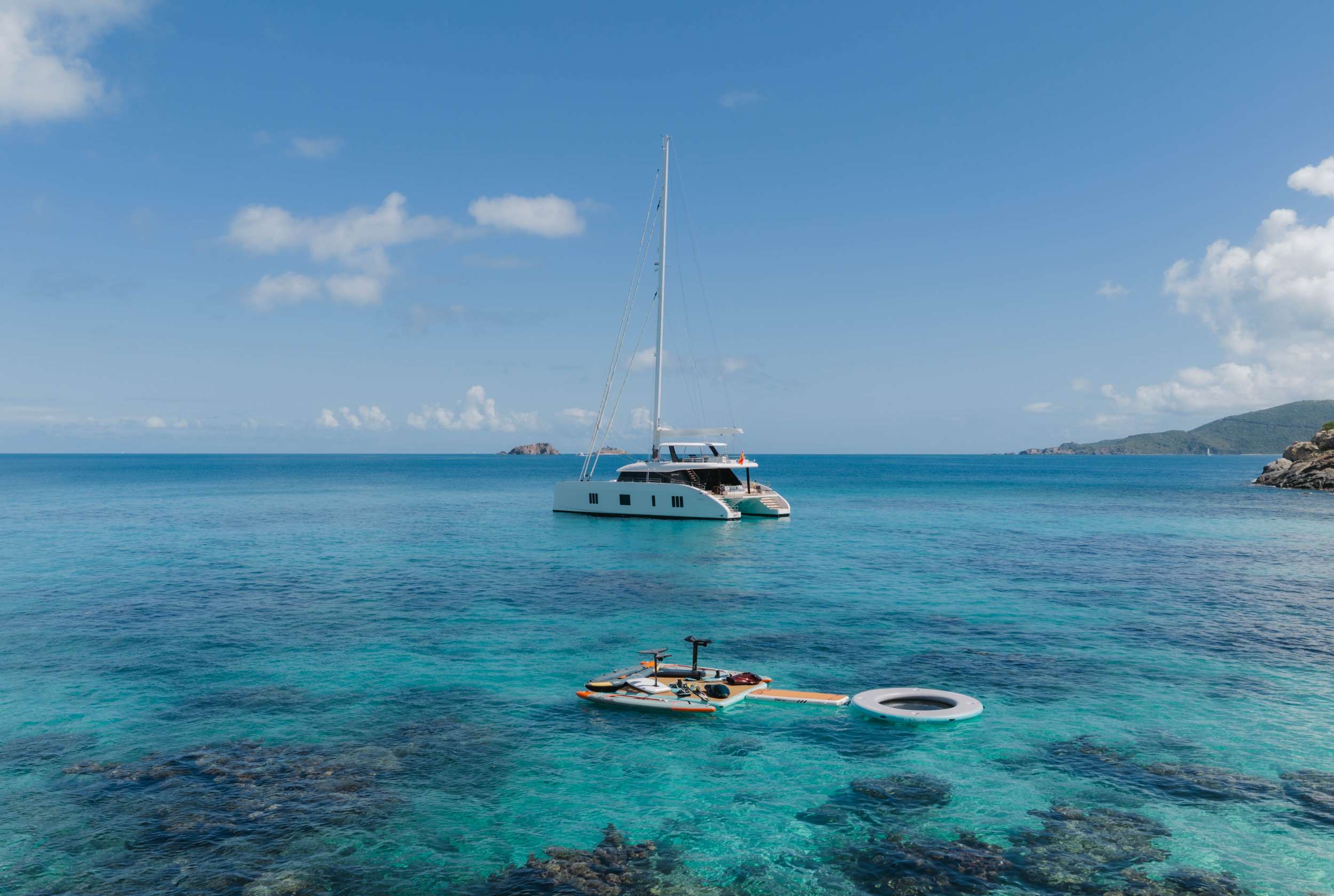
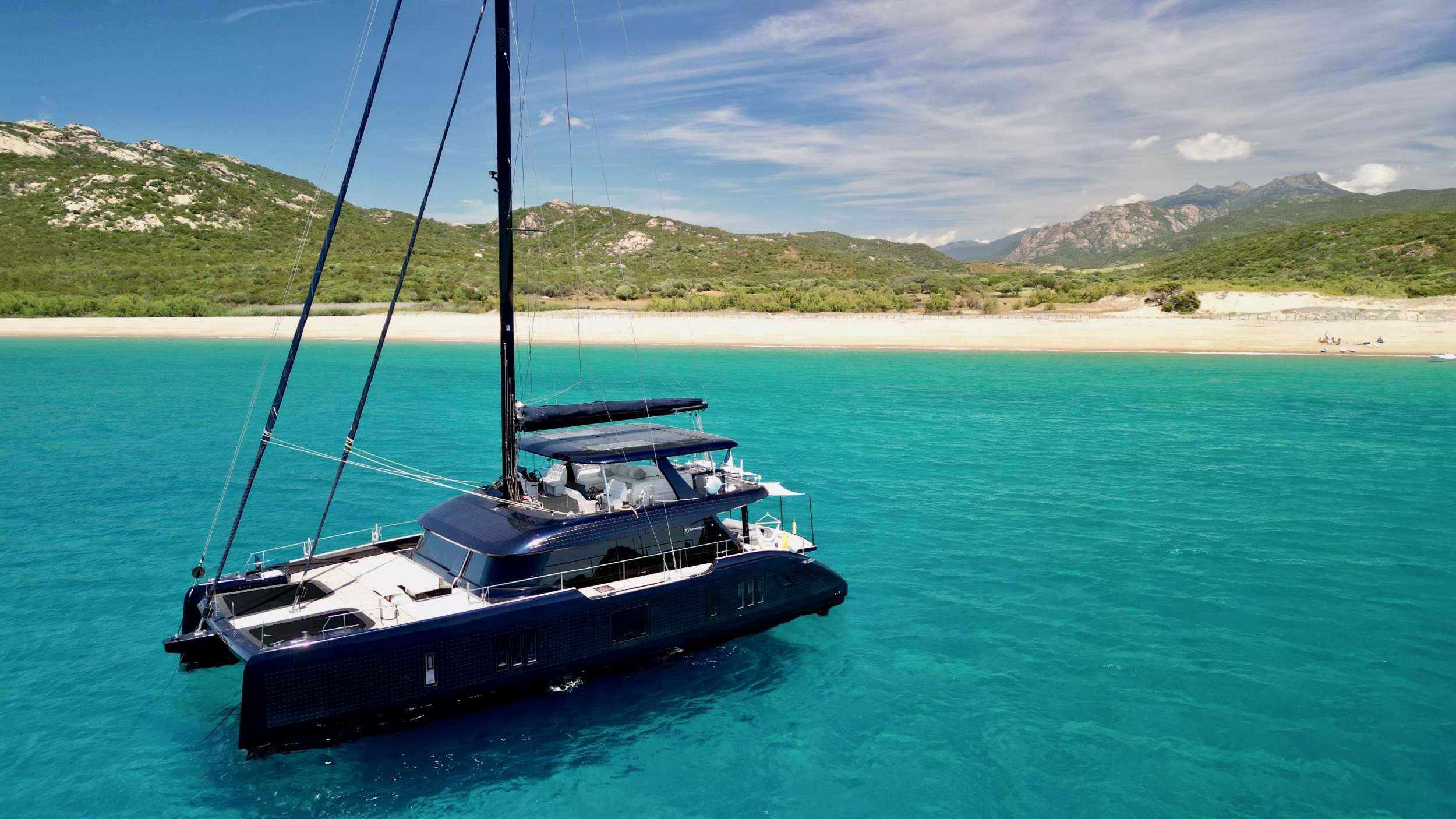


Because catamarans in the Caribbean vary widely in layout, crew, amenities, and charter terms, comparing current options is more useful than choosing by size alone. Guests searching for catamaran rentals in the Caribbean should also compare whether the yacht is fully crewed, where it operates, and what the quoted rate includes.
What Does a Catamaran Charter Cost?
The cost of a Caribbean catamaran charter varies by yacht, destination, season, guest requirements, and charter terms. Therefore, compare the full package rather than looking only at the advertised weekly rate.
Some Caribbean crewed catamarans use an inclusive pricing structure. Depending on the yacht, the rate may include the yacht, professional crew, guest accommodations, meals, standard beverages, normal cruising fuel, and use of listed water toys.
However, exact inclusions differ from one yacht to another. Premium beverages, special provisions, dockage, excursions, permits, taxes, repositioning, scuba diving, or crew gratuity may sit outside the quoted rate.
For a more detailed breakdown, see our Yacht Charter Inclusions guide.
All-Inclusive vs. Plus-Expenses Charters
An all-inclusive structure can make the starting budget easier to understand because many standard onboard expenses are already included. Still, you should confirm exactly what the individual yacht covers before booking.
In contrast, some yachts operate on a plus-expenses basis. In that case, the base charter fee generally covers the yacht and crew, while variable operating costs are paid separately.
Many plus-expenses charters use an Advance Provisioning Allowance (APA) to fund items such as fuel, provisions, beverages, dockage, port fees, and special guest requests. The captain then accounts for those expenses during the charter. You can learn more in our Advance Provisioning Allowance guide.
What Can Affect Your Catamaran Charter Rate?
Several factors can change the final charter cost:
- yacht size, age, design, and onboard features
- travel dates and seasonal demand
- destination and cruising area
- guest count and cabin requirements
- charter duration
- fuel and itinerary requirements
- food, beverages, and special provisions
- local taxes, permits, dockage, or repositioning costs
- all-inclusive versus plus-expenses charter terms
As a result, two catamarans with similar advertised rates may have different total costs once inclusions and variable expenses are considered.
Ultimately, review the yacht’s current rate, inclusions, exclusions, and expense structure together before deciding which option best fits your group and budget.

How CTC Helps You Choose the Right Catamaran
Choosing a crewed catamaran involves more than comparing photos or yacht length. Therefore, we narrow the options around the details that can shape your actual charter experience. If you plan to charter a catamaran, start with your destination, guest count, cabin needs, travel dates, and weekly budget.
Start With Your Group
First, we consider your guest count, cabin requirements, bed preferences, and children’s ages when relevant. These details help identify layouts that can work for everyone onboard.
Define Your Cruising Style
Next, we look at whether your group prefers sailing, powered cruising, a relaxed pace, or an itinerary that covers more distance.
Compare the Right Layouts
Then, we compare cabin arrangements, deck areas, water access, social spaces, and amenities that matter most to your group.
Consider Crew Fit
Meanwhile, crew style also matters. Dining preferences, service expectations, activity interests, and group dynamics can all affect which crew may suit your charter.
Match Dates and Budget
Finally, we compare your travel dates, destination, yacht location, charter terms, and approximate weekly budget before narrowing the available options.
What We Consider Before Recommending Catamarans
- Guest count and cabin configuration
- Children’s ages when relevant
- Destination and embarkation point
- Travel dates and yacht location
- Sailing or powered-cruising preference
- Preferred cruising pace and itinerary
- Crew fit and dining preferences
- Water access and onboard activities
- Important amenities and deck spaces
- Weekly budget and charter expense structure
Why this matters: Two catamarans with similar dimensions or rates can offer very different layouts, crews, amenities, and charter terms. As a result, comparing yachts against your group’s actual priorities usually provides a more useful shortlist than selecting by size or price alone. Ultimately, matching the right Caribbean catamaran charter means comparing the yacht, crew, destination, layout, and charter terms against your group’s actual priorities.
Frequently Asked Questions About Catamaran Charters
Catamarans generally heel less under sail than many sailing monohulls because their two hulls create a wider platform. However, motion and comfort still depend on the yacht design, sea conditions, wind, speed, and route. Therefore, no yacht type can guarantee a completely motion-free experience.
No. Catamaran layouts vary by builder, model, and yacht size. Some yachts have a flybridge or upper-deck lounge, while others use that space differently or do not have one at all. Therefore, check the specific deck plan before choosing a yacht based on this feature.
Cabin numbers vary considerably among crewed catamarans. In addition, bed sizes, ensuite arrangements, cabin dimensions, and crew accommodations differ between yachts. Instead of choosing by cabin count alone, compare the actual sleeping configuration with your guest list and privacy needs.
A sailing catamaran uses sails as well as engines and can make sailing part of the charter experience. In contrast, a power catamaran relies primarily on engines and may suit guests who place more emphasis on powered cruising or covering more distance.
Because speed, fuel use, range, layouts, and charter terms vary by yacht, compare individual options before deciding. You can also review our Power Catamarans guide for more detail.
They can be. Many families value separate cabin areas, shared social spaces, and convenient access to the water. However, family suitability depends on the individual yacht, children’s ages, cabin configuration, deck design, crew, and planned activities.
Therefore, tell your charter advisor about the ages and needs of everyone traveling so they can recommend more suitable options.


